
Wholesale Firewood Packaging: Boxes, Bulk Bags and What Actually Protects Moisture
Packaging is usually the last line agreed in a wholesale firewood contract, and it is the one that decides what the buyer actually receives. Two deliveries can leave the same kiln at the same moisture content and arrive in very different condition, because the format they travelled in handled storage, weather and handling differently.
This article covers the formats used in wholesale firewood packaging, what each one does for moisture stability, how they compare on transport efficiency, and which format tends to suit which sales channel.
What packaging has to do after the kiln
Kiln drying sets the moisture content. Packaging has to keep it there.
Our target for every batch is 10-18 % moisture. Wood at that level sits below the point where mould and re-absorption become a practical problem, but it does not stay there on its own. Firewood is hygroscopic: it exchanges moisture with the air around it until the two reach balance. Left uncovered through a wet autumn, a stack will climb back up. Sealed too tightly while still warm from the kiln, it can trap condensation against the wood.
Good packaging therefore does three things at once. It restricts how much damp air reaches the wood, it allows any remaining moisture to leave rather than collect, and it survives being moved several times before it reaches the end user.
Large wooden boxes
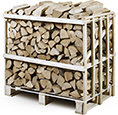
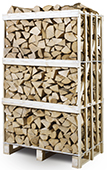
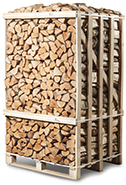
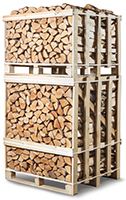
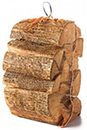
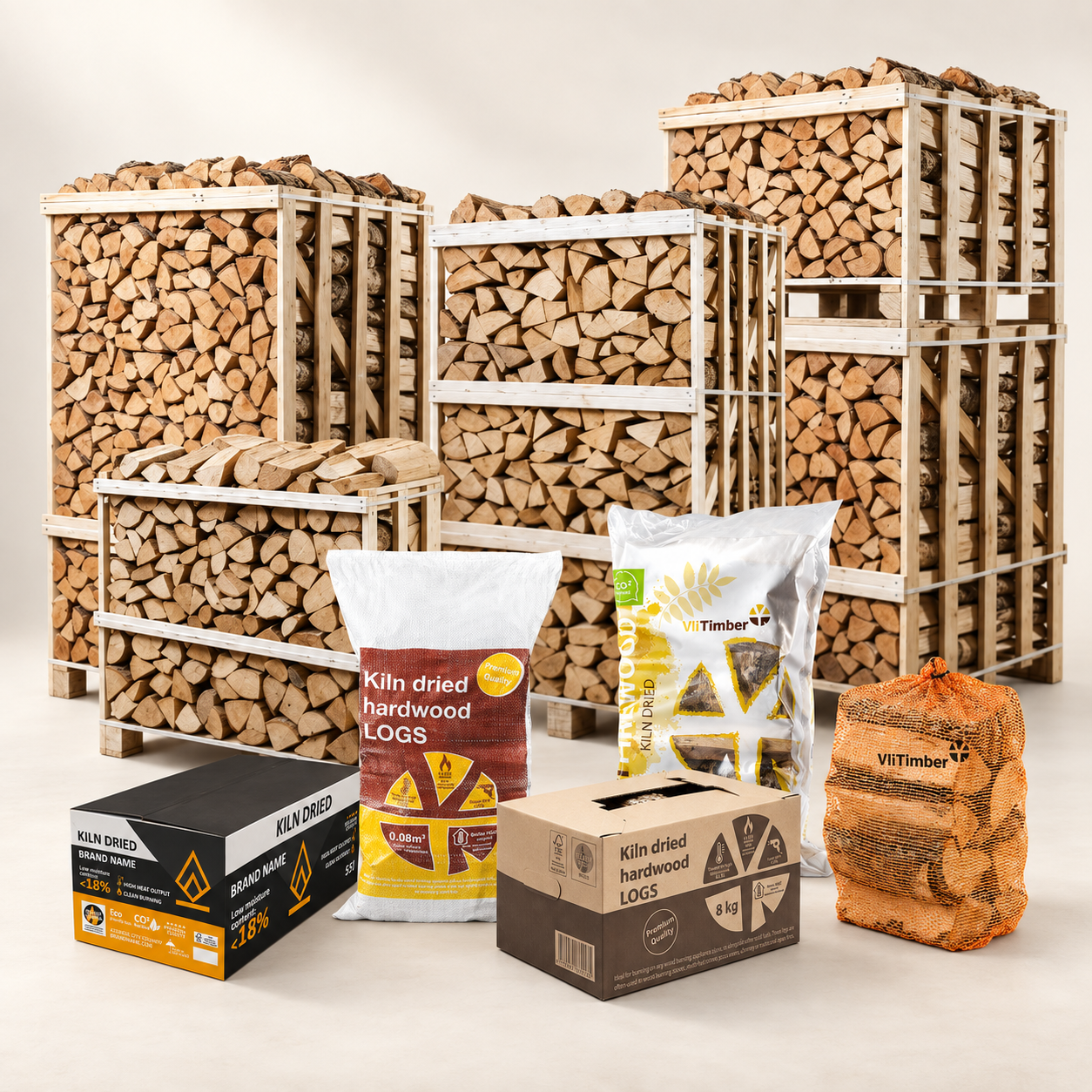
Rigid formats are the workhorses of wholesale supply. A slatted wooden box, called a crate in parts of the trade, holds its shape under stacking, protects the wood from mechanical damage, and leaves gaps that let air move through the load.
The main advantages are structural. Boxes stack predictably, which matters when a buyer is filling a warehouse rather than a garage. They tolerate repeated handling by forklift. They also keep the product visible, which retailers often prefer because customers can see what they are buying.
The trade-off is exposure. An open box does nothing against rain, so stored outdoors it needs a roof or a cover. Our range includes several box formats of different volumes, from large wholesale units to retail-sized boxes. The specifics for each are on our wholesale firewood range pages.
Bulk bags
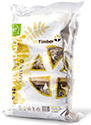
Bulk bags suit buyers who move volume and repack or sell on directly. They are lighter than boxes, cheaper per unit, and they collapse flat when empty, which reduces return logistics to almost nothing.
For moisture, the fabric matters more than the format. A woven bag breathes, which is what you want for wood that has just come out of a kiln. A fully sealed bag does not, and firewood packed warm into a sealed bag will sweat. Where bags are used for longer storage, ventilated panels and a covered storage area do more for the product than any increase in bag thickness.
Bags are also less forgiving of rough handling. They deform when stacked high, and a torn bag at the bottom of a pallet is difficult to deal with once a load is built.
Small retail formats
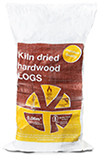
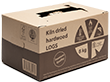
Boxes and bags for the retail shelf are a different exercise. Here packaging carries branding, barcodes, handling instructions and, in several markets, regulatory marks. Moisture performance still matters, but shelf life in a heated shop is a gentler environment than six months in a yard.
For buyers supplying supermarkets, forecourts or garden centres, the practical questions are unit weight, palletisation, shelf presentation and whether the pack can carry their own label. Private-label packaging is available, which lets a distributor put a retail range on the shelf under their own brand while the specification behind it stays the same.
Our small package range and large package range set out the formats currently produced.
What wholesale firewood packaging costs in practice
The number that decides a contract is cost per delivered cubic metre, and packaging moves that figure in several directions at once.
Rigid boxes use space efficiently and stack to full trailer height, so a load carries more product per journey. They cost more per unit and they occupy space on the way back unless they are one-way units. Bulk bags cost less and return flat, but they stack less densely and tolerate less stacking height.
Small retail packs are the least efficient per cubic metre and the most valuable per cubic metre. A pallet of 8 kg boxes carries far less wood than a pallet of bulk bags, and it sells at a different price point entirely.
The comparison worth running is the total of product, packaging, transport and handling for the channel the buyer actually serves.
Matching the format to the channel
A rough guide, which a specification conversation can refine:
Wholesale distributors reselling to trade. Large boxes or bulk bags. Priority is cost per cubic metre and handling speed at both ends.
Retail chains and garden centres. Small boxes and retail bags, palletised and shelf-ready, usually with private-label branding. Priority is presentation and unit economics.
HoReCa, including pizzerias and restaurants. Smaller boxes of consistent size and species. Priority is predictable burn behaviour and storage in a small space.
Buyers repacking under their own operation. Bulk bags. Priority is low packaging cost and simple return logistics.
What to put in the specification
Packaging deserves the same treatment as moisture and dimensions, which means a written line in the specification. The lines worth agreeing are the format and its nominal volume or weight, whether the format is one-way or returnable, how the load is palletised and secured, what markings and labels the pack carries, and which party supplies the packaging material.
Agreeing those in advance removes most of the disputes that otherwise surface on the first peak-season delivery. The same logic applies to the rest of the order, which we covered in seven questions every firewood buyer should ask.
For markets with their own requirements, the applicable marks and memberships are listed on our certificates page.
Talk to us about format
If you are planning next season’s range and the packaging question is still open, we can work through the options against your channel and volume, including private-label options for retail.
Vli Timber – Changing the Firewood Industry.