




Venice Firewood Factory: Building Wholesale Supply Reliability at Industrial Scale
A new stage in Vli Timber’s production capacity
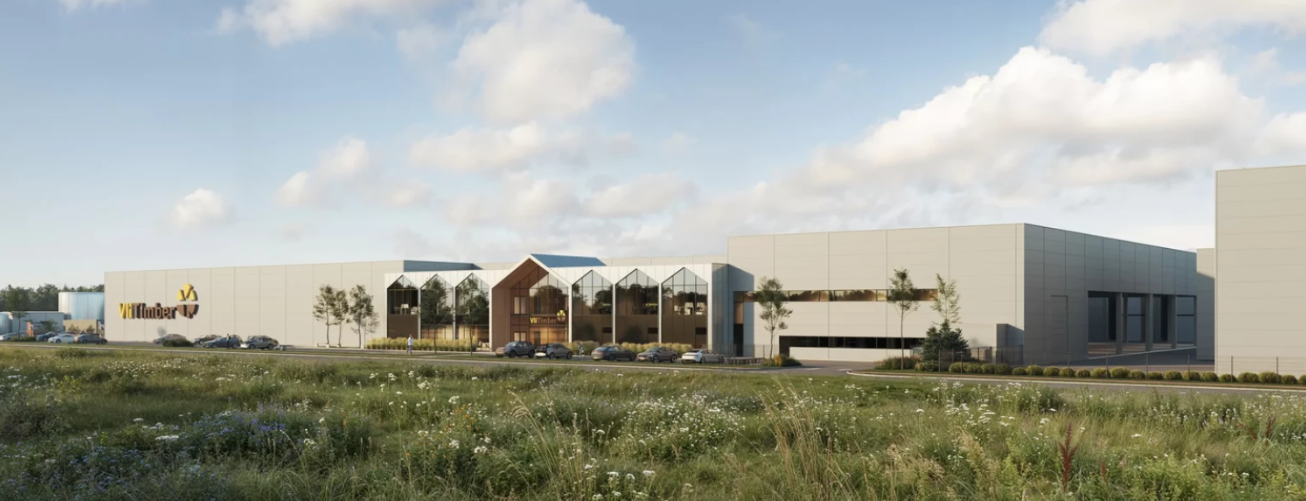
Vli Timber is developing a new production facility in Venice village, Jonava district. The project marks one of the most important growth stages in the company’s development and reflects a broader shift in the firewood industry.
The new facility will cover approximately 7,000 m² of buildings, with a total project area of around 20 hectares. Once operational, it is planned to process up to 200,000 m³ of wood per year and create more than 150 jobs.
For Vli Timber, this project is not only about increasing production volume. It is about building a more reliable, scalable and engineering-led model for wholesale dry firewood production.
This is a practical example of what we mean by Changing the firewood industry.
Why wholesale dry firewood requires more than volume
In wholesale markets, production capacity matters, but volume alone is not enough.
Retailers, importers and distribution partners need a dry firewood supplier that can provide consistent quality, stable specifications and reliable delivery planning. This is especially important in markets where seasonal demand can change quickly and supply chains must be prepared months in advance.
For buyers of wholesale kiln-dried firewood, the key requirements are usually clear:
- predictable moisture content;
- consistent product specifications;
- stable packaging formats;
- reliable production volumes;
- long-term supply planning;
- clear communication with the producer.
This is why industrial scale has to be supported by process control. A larger factory creates value only when it improves consistency, not just output.
From seasonal production to industrial supply planning
Firewood has traditionally been connected to seasonal production and seasonal demand. In smaller operations, production planning often depends on weather, storage conditions and available labour.
For large-scale industrial firewood production, this model creates limitations.
A wholesale buyer does not only need firewood when the heating season begins. They need production planning, stock preparation, logistics coordination and predictable availability before peak demand arrives.
The Venice Firewood Factory is being developed with this supply chain logic in mind. Its role is to strengthen Vli Timber’s ability to plan production at industrial scale and support customers with more stable long-term supply.
This is one of the main differences between traditional firewood production and a modern kiln-dried firewood manufacturer.
Engineering scale: 20 hectares, 7,000 m² and up to 200,000 m³ per year
The scale of the Venice project is significant.
The facility is planned on a territory of around 20 hectares, with approximately 7,000 m² of production buildings. Its planned annual processing capacity is up to 200,000 m³ of wood per year.
By comparison, Vli Timber’s existing factory in Anykščiai is able to process approximately 125,500 m³ of wood per year. The new facility will therefore create a stronger production base for wholesale and export markets.
This increase in firewood production capacity supports several long-term goals:
- higher production resilience;
- better preparation for peak demand;
- stronger supply reliability for wholesale partners;
- improved ability to manage larger orders;
- more stable production planning across seasons.
For Vli Timber, capacity expansion is not only a growth metric. It is part of a wider strategy to make dry firewood production more predictable, controlled and suitable for international B2B supply.
What this means for wholesale partners
For wholesale partners, the value of the Venice Firewood Factory is practical.
The project is expected to strengthen Vli Timber’s ability to support larger and more consistent orders. This matters for retailers, importers and distributors who need stable supply rather than one-time availability.
A reliable bulk firewood supplier has to manage more than production. It also has to coordinate raw material flow, drying capacity, packaging, storage, logistics and documentation.
The Venice facility is being developed to support this wider system.
For partners, this can mean:
- more reliable access to wholesale dry firewood;
- better long-term volume planning;
- stronger preparation for seasonal peaks;
- more consistent product specifications;
- improved supply chain confidence.
In wholesale firewood supply, reliability is created before the product leaves the factory. It starts with how production is designed.
Automation and long-term production stability
The Venice Firewood Factory is planned as an automated and engineering-led production facility. This direction is important because firewood production at scale requires more than labour and storage space.
It requires controlled production flow.
Automation can support:
- more efficient wood preparation;
- more consistent processing;
- better use of production equipment;
- reduced bottlenecks;
- improved planning across production stages.
In automated firewood production, each stage has to work as part of a system. Wood preparation, drying, packaging and logistics must be connected in a way that supports consistent output.
This is where engineering becomes central. The objective is not only to produce more firewood, but to reduce variability and make production more predictable.
Responsible use of wood resources
Vli Timber’s production model is also connected to more efficient use of wood resources. The company processes wood that is suitable for energy use but not intended for higher-value construction or industrial wood products.
This approach helps create value from raw material that would otherwise have limited applications in other wood industries.
For industrial dry firewood production, this requires process discipline. Natural raw material can vary in diameter, density, shape and moisture. To produce a standardized product, the manufacturing system has to manage this variability through preparation, controlled drying and quality checks.
The goal is not simply to use more wood. The goal is to use available wood resources more efficiently and turn them into a consistent energy product.
This is an important part of Vli Timber’s long-term production logic.
Changing the firewood industry through scalable production
For Vli Timber, Changing the firewood industry is not a slogan about size. It describes a practical shift in how firewood is produced, planned and supplied.
The industry is moving from:
- seasonal production;
- manual handling;
- weather-dependent drying;
- variable product quality;
- short-term supply planning;
toward:
- industrial production capacity;
- controlled kiln-drying;
- automated production processes;
- consistent specifications;
- scalable wholesale supply.
The Venice Firewood Factory is a clear step in this direction.
It shows that dry firewood can be produced with the same principles used in other modern manufacturing sectors: engineering, process control, automation, planning and continuous improvement.
A future-ready model for wholesale kiln-dried firewood
The demand for wholesale kiln-dried firewood is shaped by practical requirements. Buyers need a product that is dry, consistent, available in planned volumes and suitable for distribution across different markets.
To meet these expectations, producers need more than traditional experience. They need production systems that can support scale and quality at the same time.
The Venice Firewood Factory is being developed to strengthen this capability.
With planned capacity of up to 200,000 m³ of wood per year, the new facility will help Vli Timber build a stronger foundation for international wholesale supply and long-term customer relationships.
The Venice Firewood Factory in Jonava district represents a major step in Vli Timber’s development.
With around 20 hectares of total project area, approximately 7,000 m² of buildings, planned capacity of up to 200,000 m³ of wood per year and more than 100 new jobs, the project has significant industrial scale.
However, its importance is not only in the numbers.
The real value of the project lies in the production model behind it: automated, engineering-led and designed for reliable wholesale dry firewood supply.
For Vli Timber, this is what Changing the firewood industry means in practice: building a more controlled, scalable and future-ready approach to dry firewood production.